Payments
Recover 2–3% on Card Payments: Automatic US Surcharge Caps by State
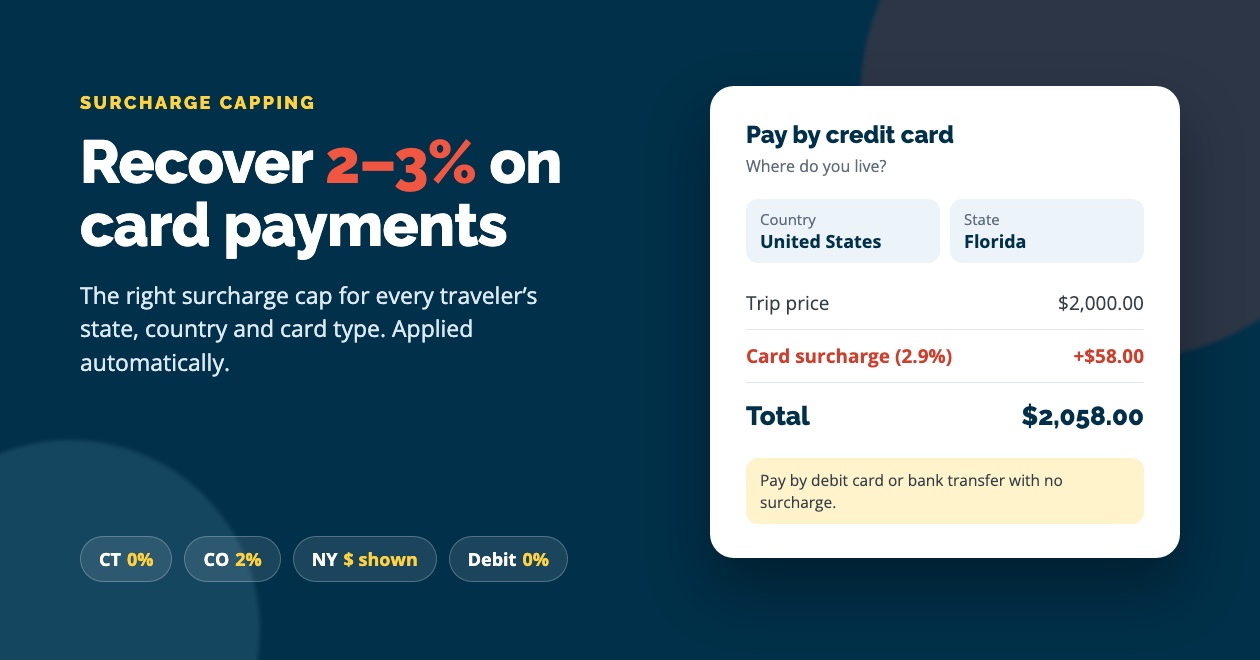
Every credit card payment costs a US travel business roughly 3%. Many absorb it, not because they want to, but because the surcharge rules change from state to state. YouLi’s new Surcharge Capping does the state-by-state work for you, so merchants of record can recover those costs with confidence.
- Stay in control
- Recover 2–3%
- Capped by state
- No extra cost
Why so many US travel businesses don’t surcharge
Passing card fees on to the customer is legal in most of the US. So why do so many tour operators, retreat hosts and group travel planners still swallow the cost?
Because the rules are hard to follow by hand:
- The cardholder’s location sets the rules, not yours. A Colorado business taking a payment from a traveler in Massachusetts has to follow Massachusetts rules.
- Some states ban surcharges outright. Connecticut, Massachusetts and Maine allow 0%.
- Some states cap them lower. Colorado and Oklahoma cap surcharges at 2%, or your actual cost if that is lower.
- Some states have their own disclosure rules. New York, for example, requires the dollar amount to be shown, not just a percentage.
- Debit cards can’t be surcharged, even though they look just like credit cards at checkout.
A group trip can easily include travelers from a dozen states. Working out the right surcharge for each payment, by hand, isn’t realistic. So the safe choice has been to charge nothing and lose the margin.
What 2–3% means for your business
Card fees look small on a single payment. Across a season of group bookings, they add up quickly.
| Example | Card payments | Surcharge at 2.9% |
|---|---|---|
| One traveler on a $2,000 trip | $2,000 | $58 |
| A 20-person departure | $40,000 | $1,160 |
| A year of bookings | $500,000 | $14,500 |
These figures are illustrative. Your result depends on your card mix, where your travelers live and which payment methods they choose. But for a business that has been absorbing every card fee, recovering even part of that cost goes straight to the bottom line, without raising your advertised trip price.
Being the merchant of record means staying in control
With YouLi, your payments settle into your own Stripe account. You are the merchant of record: you hold the funds, you own the customer relationship, and you decide your payment terms. Many travel businesses choose YouLi for exactly that reason. They don’t want a platform sitting between them and their money.
Control also comes with responsibility, including for how you surcharge. Our job is to give you tools that make that responsibility easier to carry. Surcharge Capping is one of those tools.
How Surcharge Capping works
You set one surcharge rate for each payment method, usually your processing cost. If you pay Stripe’s standard 2.9%, set 2.9%. YouLi then lowers the rate automatically wherever the rules require it.
- Your traveler sees your trip price on your website, sales page or checkout, for example $2,000.
- The invoice lists the payment methods and shows which ones may carry a surcharge. Debit cards always appear as their own option, with no surcharge.
- If they choose a method with no surcharge, such as debit or one of your no-fee direct payment methods, they pay the trip price.
- If they choose a credit card, they enter their country and, in the US, their state. YouLi applies the right cap and shows the actual dollar amount: $2,000 + $58 = $2,058.
- They decide to pay, switch payment method or cancel, before entering any card details.
Surcharge Capping always uses the stricter disclosure approach, so the same checkout flow works in every state.
US caps applied automatically (may change)
| Cardholder location | Cap YouLi applies |
|---|---|
| Most US states (credit card) | 3% |
| Any state (debit card) | 0% |
| Connecticut, Massachusetts, Maine | 0% |
| Colorado, Oklahoma | 2% (or your cost, if lower) |
| Minnesota | 3% (the federal cap is lower than the state’s 5%) |
| New York, California, New Jersey, Georgia, Kansas | 3%, with the checkout showing the dollar amount and a no-surcharge option |
The full detail, including the extra requirements in some states, is in the Surcharge Capping help article.
An automation you won’t find elsewhere
As far as we know, YouLi is the only group travel booking platform that caps surcharges automatically by the cardholder’s state, country and card type. Most platforms give you one choice: switch surcharging on for everyone or off for everyone. Surcharge Capping gives you a third option. You recover your costs where the rules allow it, and the checkout charges 0% where they don’t.
It also works alongside the rest of YouLi’s payment tools:
- No-fee direct payment methods such as wire transfer, which you can set to 0% to steer travelers away from cards.
- Adaptive Pricing, so the surcharge follows the chosen payment method in any currency.
- Require a card on deposit, which shows only card methods when you need them.
- The Convenience Fee, if you’d rather apply one flat fee to every payment method.
Get started
Surcharge Capping is available on request, at no extra cost. Open a support ticket to ask for access, then set your rates per payment method. We recommend checking your setup with your accountant or legal advisor before you turn it on.
Frequently asked questions
Do I need to be the merchant of record?
Yes. Surcharge Capping is for businesses that take payments into their own Stripe account through YouLi. You collect the surcharge, so the responsibility for it is yours too.
Whose location decides the cap: mine or my traveler’s?
Your traveler’s. The rules follow where the cardholder lives, not where your business is incorporated. That’s why the traveler enters their country and state before a surcharge is shown.
Can travelers be surcharged on a debit card?
No. Debit cards always appear as a separate option with no surcharge, in every jurisdiction.
Can I charge more for Apple Pay or Google Pay?
No. Wallets may cost you more, but their surcharge can’t be higher than your card surcharge. You can still list them as separate payment options.
Does Surcharge Capping cost extra?
No. Request access through a support ticket and there’s no additional cost to you.
Sources for further reading
- YouLi Help Center: Surcharge Capping by State and Payment Method (for US)
- YouLi: Planner agreement
- YouLi blog: Australia card surcharge changes: absorb, reprice or mix?